New World Screwworm
What is New World Screwworm (NWS)?
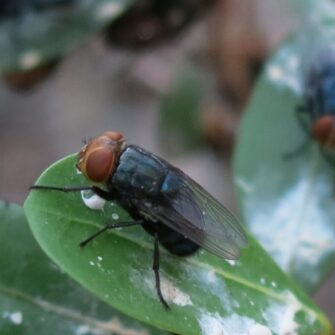
New World Screwworm (NWS) is a species of parasitic fly that feeds on live tissue and can cause a painful condition called myiasis. Infestations happen when the larvae (maggots) from a NWS fly infest the tissue or flesh of warm-blooded animals (e.g. humans, dogs, cats, cows, birds). NWS flies are attracted to open wounds and will lay eggs in open wounds. The name screwworm refers to the feeding behaviors of the larvae as they screw (burrow) into the wound.
How it Spreads
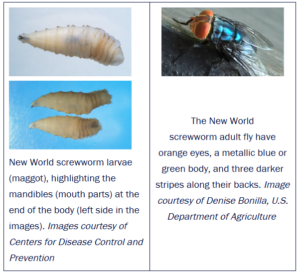
New World Screwworm infestations begin when a female lays eggs on open wounds or other parts of the body in live, warm-blooded animals. It primarily affects livestock but can also infest birds and humans. The female NWS fly lays eggs in open wounds or other parts of the body such as mucous membranes (nose, eyes, or mouth) or the umbilical cord of a newborn animal. Wounds as small as a tick bite can attract a female fly who may lay 200-300 eggs at a time and up to 3,000 eggs in the 10-30 day lifespan.
Signs and Symptoms
Humans
- NWS infestations are very painful and can cause severe wounds. If you have a NWS infestation, you may see larvae (maggots) around or in an open wound. Larvae could also be in your nose, eyes or mouth. Symptoms can include:
- Unexplained skin lesions (wounds or sores) that do not heal or go away
- Skin wounds or sores that worsen over time
- Painful skin wounds or sores
- Bleeding from sores or wounds
- Feeling larvae movement within skin wounds, sores, nose, mouth or eyes
- Seeing larvae around or in an open wound or sore.
- A foul smelling odor from the site of infestation
Animals
- When NWS larvae (maggots) infest an animal, the wounds can be small to large depending on damage caused by the larvae’s sharp mouth hooks. As more eggs hatch and more larvae feed on the tissue of an animal, the larger and deeper the wound gets. Some additional symptoms in animals are:
- Foul-smelling wounds with visible maggots
- Animals biting or licking at wounds
- Lesions in navels, ears, dehorning or branding sites
- Unusual restlessness or lethargy

Picture of screwworm infestation in a dog. Image courtesy of Texas A&M AgriLife
Endemicity/Geography
NWS is native to the Western Hemisphere and endemic in several Caribbean countries such as Cuba, Haiti, and the Dominican Republic, as well as in South America. In 2023, NWS detections increased in Panama and since then it has spread north into Central America.
Risk in the U.S.
Before 1960, NWS was a major problem in the southern U.S. costing livestock producers in the southeast $10-20 million per year and costing producers in the southwest $50-100 million per year. It was eradicated from the U.S. in 1966 using the sterile insect technique where sterile male flies are released to mate with wild females. However, there have been occasional outbreaks in southern U.S. wildlife populations and sporadic cases of NWS in the U.S. from residents traveling to endemic areas. People who travel to areas where NWS is typically found are at a higher risk. Risk factors for people who travel to NWS endemic areas are:
- Having an open wound from a scratch, cut, insect bite or from a recent surgery.
- Having a weakened immune system (e.g., from HIV, cancer treatment, or medications that weaken your immune system).
- Having a medical condition that can cause bleeding or open sores such as from skin or sinus cancer.
- Sleeping outdoors.
- If you live, work or spend extended periods of time with livestock or other warm-blooded animals in these areas.
To see the most current updates about where NWS has been detected in Mexico and if it is present in the U.S., visit the USDA’s webpage.
Prevention and Control
How to protect yourself and livestock or domestic pets:
- Keep wounds or sores clean and covered
- Please see a healthcare provider if a wound or sore is not healing or is getting worse
- Use an EPA-registered insect repellent https://www.epa.gov/insect-repellents/find-repellent-right-you
- Treat clothing and gear with products containing 0.5% permethrin
- Sleep indoors or in rooms with screens
- Protect pets and livestock from wounds
- Make sure pets traveling internationally, especially to endemic areas or outbreak areas, are inspected for screwworm prior to returning home to the U.S.
- Protect pets and livestock from other wound-causing parasites such as ticks
- Treat the umbilical cords of newborn animals and all wounds with an approved insecticide in consultation with a veterinary professional
Information for Providers and Reporting
Please click here to visit our New World Screwworm page at the Office of State Epidemiology for provider information and reporting to public health and/or Nevada Department of Agriculture.
Resources
About New World Screwworm | CDC
Clinical Overview of New World Screwworm | New World Screwworm | CDC
New World Screwworm Outbreak in Central America and Mexico | USDA
New World Screwworm – Texas A&M AgriLife Extension Service
Bring a Pet Dog into the United States | USDA.
Back to All